A Room-Temperature Extreme High Vacuum System for Trapped-Ion Quantum Information Processing
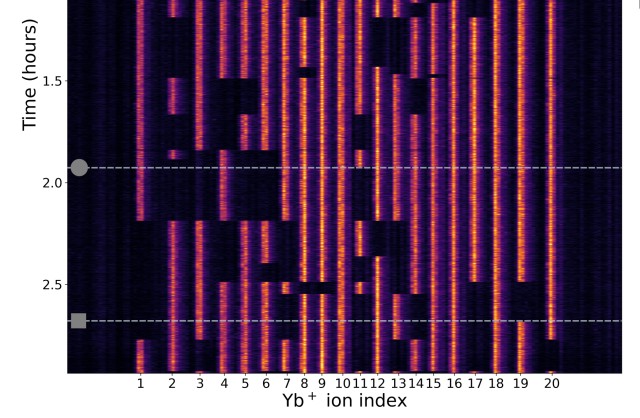
Abstract: We present a room-temperature Extreme High Vacuum (XHV) system engineered to support the long-duration operation of a trapped-ion quantum processor. Background-gas collisions impose limitations on trapped-ion performance and scalability by interrupting algorithmic execution and, in some cases, ejecting ions from the trap. Using molecular-flow simulations, we optimize the chamber geometry, conductance pathways, and pumping configuration to maximize the effective pumping speed at the ion location. We perform high-temperature heat treatment of stainless steel vacuum components to achieve the desired outgassing rate, guided by quantitative relations of bulk diffusive processes, allowing us to reduce the H2 outgassing load to the 10−15 mbar l s−1 cm−2 level. The final pressure in our chamber, measured by a hot cathode gauge, is 1.5 ×10⁻¹² mbar, corresponding to the gauge’s measurement limit. We measure the local pressure at the ion location by observing collision-induced reordering events in a long ion chain of mixed-isotope Yb+. From the observed reordering frequency, we extract the average interval between collisions to be (1.9 ± 0.1) hrs/ion. This corresponds to a local pressure of (3.9 ± 0.3) × 10−12 mbar at the ion location, assuming that all collisions arise from background H2 molecules at room temperature. Our demonstration extends the continuous operation time of a quantum processor while maintaining the simplicity of a roomtemperature system that does not require cryogenic apparatus.