Quantum Simulations
Trapped ions allow us to simulate a variety of quantum systems that are otherwise intractable.
Overview
Quantum simulators are purpose-built quantum processors designed to emulate the dynamics of quantum systems that are otherwise intractable to study with classical computation or conventional experiments. They enable us to investigate how interacting quantum particles, under external fields and engineered couplings, self-organize into collective quantum phases, offering a pathway to uncover the microscopic origins of emergent phenomena such as unconventional superconductivity. Beyond reproducing known models, quantum simulators let experimentalists design their own “quantum universes”: by programming interaction rules and tailoring how the system exchanges energy and information with its environment, one can stabilize and explore novel phases of matter that may not occur naturally. In this way, quantum simulators serve as controlled laboratories for testing what kinds of many-body behavior are permitted by the laws of physics, independent of whether nature happens to realize them in an accessible material.
Quantum simulation is widely viewed as one of the earliest routes to quantum advantage: a purpose-built quantum device is expected to outperform classical computation on well-defined simulation tasks before fully general-purpose quantum computing becomes practical. In this context, platform flexibility matters. The more control a simulator offers over interactions, state preparation, and measurement, the stronger its prospects for reaching regimes where classical methods fail.
Trapped-ion systems are among the most powerful platforms for quantum simulation, combining long coherence times with exceptionally precise control over initialization, interactions, and measurement. At the Laboratory for Quantum Information with Trapped Ions (QITI), we develop and deploy trapped-ion quantum simulators to explore a broad range of many-body dynamics and emergent phases, including both Hamiltonian and engineered open-system simulations.
What we do
We are interested in several kinds of quantum simulations in our research:
- quantum simulation of spin Hamiltonians.
- quantum simulation of open systems that exchange energy with environment at a controlled rate.
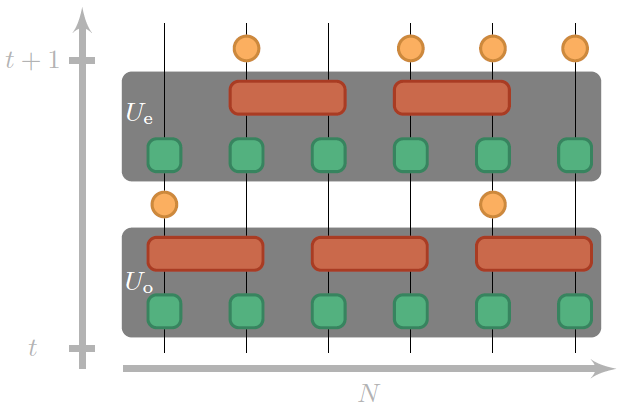
- quantum simulation of monitored systems, i.e., where entanglement generation and measurement compete with each other.
More details coming soon.